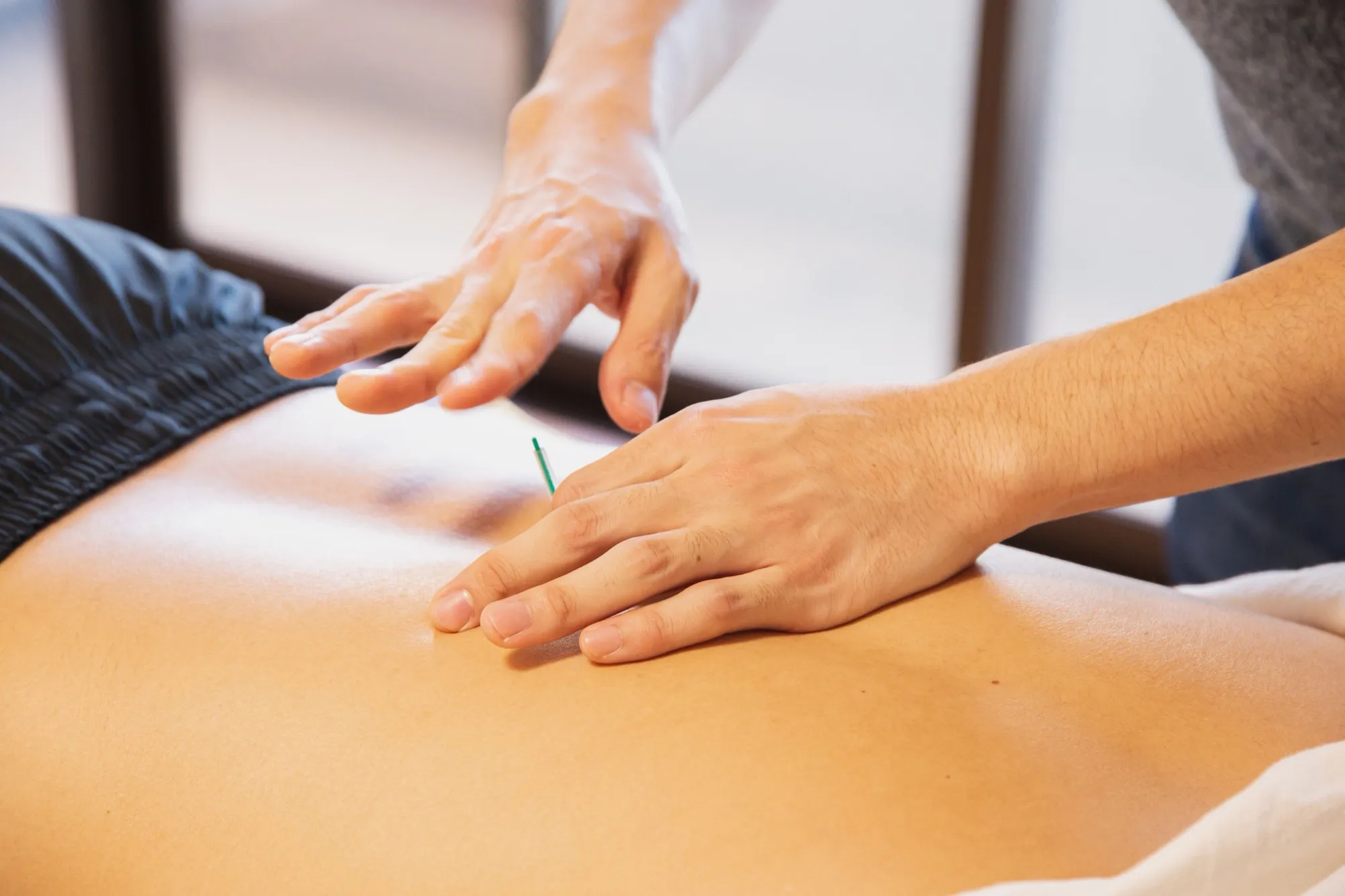
Dry needling comes up constantly and is explained badly almost every time. Here is the short version.
What it is
A thin filament needle, inserted into a trigger point: a taut, irritable band within a muscle that refers pain elsewhere and limits how that muscle works.
It is “dry” because nothing is injected. The effect comes from the mechanical contact. When the needle reaches the trigger point you often get a local twitch response, a brief involuntary contraction that most people describe as a deep cramp releasing in a second or two.
What it is not
It is not acupuncture. The needle looks similar and that is where it ends. Acupuncture is rooted in traditional Chinese medicine and works from meridians and energy flow. Dry needling is a Western technique targeting a specific muscle identified by physical examination. Different reasoning, different targets, different training.
It is also not a massage, and most importantly it is not a treatment on its own.
Where it actually helps a golfer
The muscles that tend to matter in golf are predictable: glute medius and piriformis around the hip, the thoracic paraspinals, lats, and the rotator cuff group in the lead shoulder.
A trigger point in one of those can lock down a range of motion in a way that stretching does not resolve. You stretch, it feels better for an hour, and it returns. That pattern, relief that never lasts, is often a trigger point rather than a genuinely short muscle.
Referral patterns are consistent and well documented, which is why so many people spend months treating the wrong area. Glute medius refers down the outside of the hip and thigh, and a great many people have been treating a hip or an IT band that was never the problem.
Why it is not a standalone treatment
Needling opens a window. What happens inside that window is what decides whether anything changes.
Release a restriction and do nothing else, and you get a few good days before it drifts back. The muscle was compensating for something, and the something is still there.
Release it and immediately load the newly available range, retrain the pattern, and send the person away with a home programme that keeps using it, and the change has a reason to persist.
That is why, in this practice, dry needling is included at no extra cost inside every visit package rather than sold separately. It works considerably better as one part of an hour than as a service in its own right.
Practical notes
Expect soreness for a day, similar to having trained hard. Drink water, keep moving normally, and do not schedule it the day before a round you care about until you know how you personally respond.
Tell your clinician beforehand if you take anticoagulants, have a bleeding disorder, are pregnant, or have a pacemaker. None of those are automatically disqualifying, but they change the conversation, and that conversation should happen before a needle appears rather than after.
The question worth asking
If someone offers you dry needling without first examining you and working out which muscle is actually driving your problem, they are treating where it hurts rather than why it hurts.
Ask them which muscle they are targeting and why they think that one is causing your symptoms. A good answer is specific.
Brian Bolin is a Doctor of Physical Therapy certified in dry needling, treating golfers and active adults across Collier County.